Trout are the symbol of the
Great Smoky Mountains
National Park’s fish.
most difficult to catch.
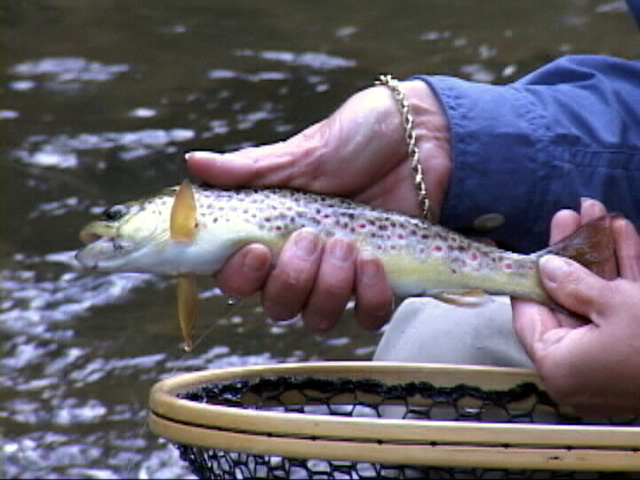
brown trout are less prone that
than rainbows or brook trout.
This one took a dry fly. Although it
does occur , just not as often.

(Brook, Brown & Rainbow)
by Ian Rutter:
Streams-Catching the Grand
Slam is a DVD features
author Ian Rutter. Ian catches
Fly-fishing Eastern Freestone
all 3 species of trout in the
park in one day and explains
the different methods for each
species.
Click here to purchase and for more information
(Brook, Brown, Rainbow &
Cutthroat)
This DVD covers the different
species of trout and the
methods and techniques used
to catch each type. Shot
nationwide on several streams.
Click here to purchase & for more information
Click here to purchase & for more information
Click here to purchase & for more information
There are three (3) species of trout that you can catch fly fishing Great Smoky Mountains National Park – the brown, brook and rainbow trout. Each species requires different methods and techniques of fishing if you’re going to be consistently successful in catching them on the fly.
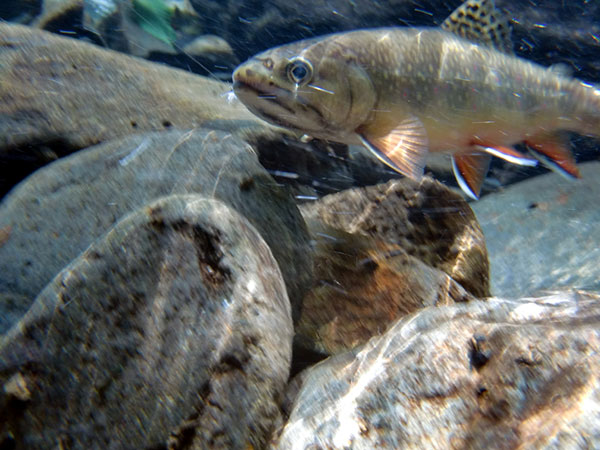
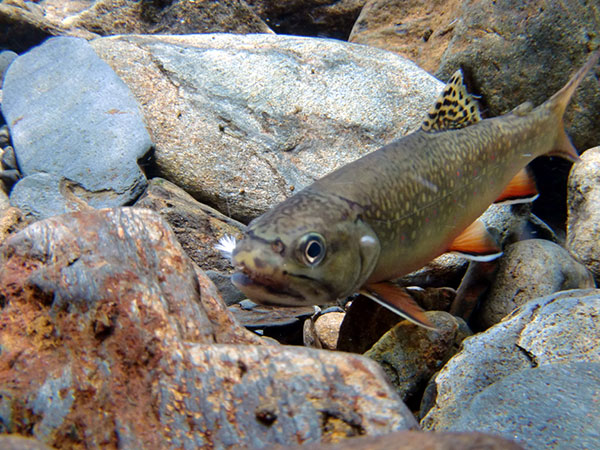
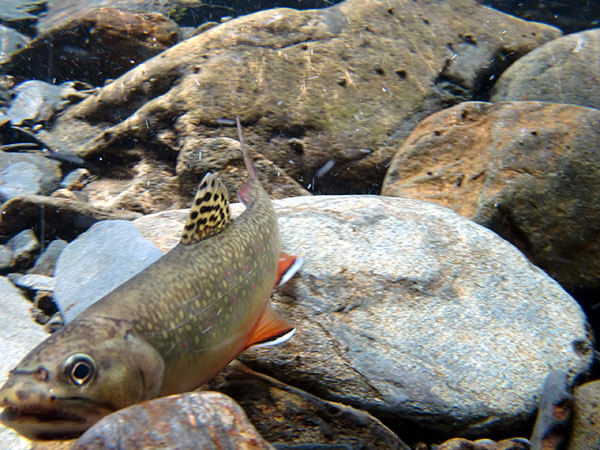
Brook Trout
Park’s trout. Actually, it’s not even a trout. It’s a member of the char family of fish. It’s the only native fish that’s of prime interest to the fly angler.
At one time, brook trout were found in just about all the streams in the Smoky Mountains. In the 1880’s, primitive logging techniques caused huge population loses. Many of these populations were replaced by rainbow trout. Most all of the brook trout now reside in streams that are above 3000 feet in elevation. Many of the streams in the park, approximately 150 miles of them, were only recently opened to brook trout fishing after being closed for approximately thirty years. At the present time, there are a few short sections of brook trout streams that are still closed to protect and restore the native species to their original habitat. It has been reported that about 17 miles of streams have been restored by the Great Smoky Mountains National Park fishery managers with a pure brook trout population.
Brook trout spawn in the Fall. The juveniles stay hidden in the gravel until Spring. They average 4 to 8 inches in length and rarely exceed 12 inches. A brook trout over 10 inches long should be considered a trophy.
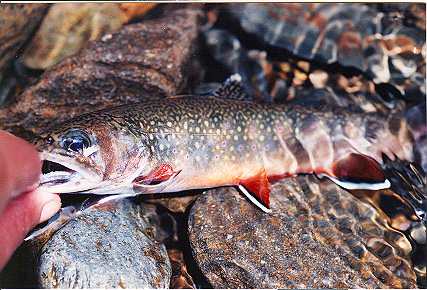
The brook trout has a brown to a dark green basic color with a distinctive marbled pattern of lighter shades across the sides and back and extending to the dorsal fin, and often to the tail. There’s a very distinctive scattering of red dots, enclosed by blue colors along the flank. The belly and lower fins are reddish in color and the fins have white leading edges. Often the belly, particularly the males, becomes very red or orange when the fish are spawning.
They prefer water temperatures of less than 68 degrees F. They rarely live longer than five years and usually only three years.
Rainbow Trout
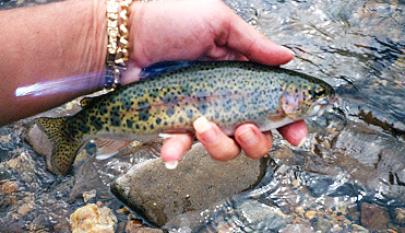
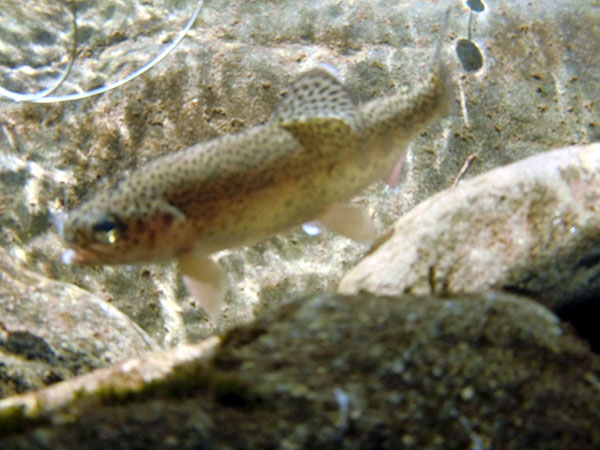
The rainbow trout is native to the Western United States. It was at one time stocked. It isn’t frequently that you catch one that’s twelve inches long or better. You will find the rainbow in faster water out in the open, hiding only under the cover of a broken surface of water. They tend to feed on the surface more so than the other trout. Of course, they will spook very easily if danger approaches. They prefer temperatures ranging from the mid fifties to the high sixties. They can survive in water temperatures as low as 32 degrees F and as high as 80 F. The rainbow is the most sought after trout in the park, probably because it’s the most plentiful species. It also is an exciting fish to catch. Rainbows tend to jump more than the brown or the brook trout. They are found in most all of the streams in the park. They spawn in the Spring.
Rainbow trout have a pink or red line that runs from their gill cover to their caudal fin. They get their name from this rainbow line. Rainbow trout are native to streams in the Western United States and Canada that flow into the Pacific Ocean. Although they were stocked at one time in the Smoky Mountains National Park they are now managed as stream-bred, wild trout.
Brown Trout
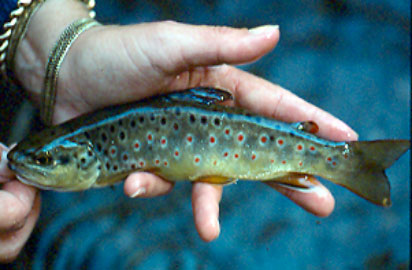
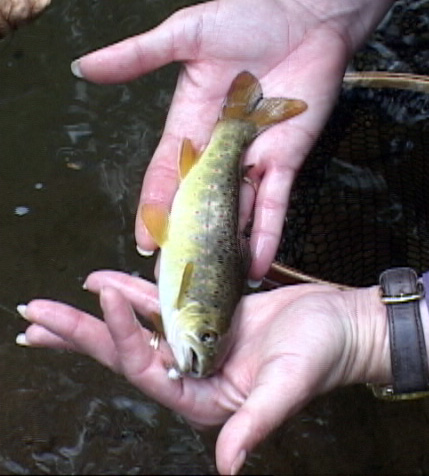
The brown trout is originally from Europe. It was at one time stocked (during the 1950s) in waters that flow from the park and thereby made its way into several of the park’s streams. Of the three trout species, It’s the largest to be found in the park. Brown trout are very difficult to spot in a stream. They can actually change their color to blend in with their surroundings. They are also capable of resting on the bottom of the stream and when they do, they look much like the bottom.
Browns are found mostly in streams in the lower elevations. They prefer water temperatures ranging from the mid 50’s up to the high 60’s F. They are capable of surviving in water temperatures as high as eighty degrees F.
Most smaller brown trout, those less than 12 inches long, feed on insects as well as a large variety of other foods. Once they reach a larger size they tend to change their feeding habitats and prey on bait fish, crustaceans and even other small trout. This allows a few of them to grow to a very large size.
It has always been assumed that the brown trout hides under rocks and crevices in the banks most of the day and that they prefer to feed only under low light conditions. This is not nearly as true as once thought. They will generally feed most of the time they are undisturbed for long periods of time. It’s certainly true that they are very difficult to approach without spooking them and during the time anglers are attempting to do so, they definitely hide under rocks.
Brown trout spawn in the Fall. During this time the trout (especially the males) can be very aggressive. Both the males and the females tend to lose their normal caution and completely expose themselves at times. Although anglers find it very difficult to pass up a large brown trout involved in the spawning process, they should. Catching a big brown trout while it’s spawning and/or protecting its redd is certainly nothing to take pride in even though it may be legal to do so. In our opinion it’s unsportmanlike.
Copyright 2011 James Marsh

Best Smoky Mountain Flies
Click here to purchase & for more information